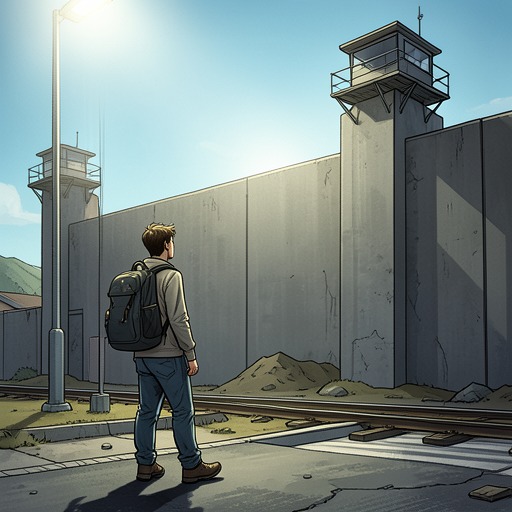
Saladin Kader
World War ZSaladin Kader is a professor of urban planning at Khalil Gibran University and one of the interview’s most revealing witnesses to the collapse of political certainty during the Zombie War. Born and raised in Kuwait City, he begins as a sheltered young Palestinian shaped by inherited grievance and contempt for Israel; he emerges from the crisis having discovered that the people he thought he understood were strangers, and that the enemy described by Israel was real.
Identity and Background
Saladin’s family belonged to the minority of Palestinians who were not expelled from Kuwait after 1991, when Yasser Arafat sided with Saddam Hussein against the international coalition. His family was neither wealthy nor impoverished, but Saladin describes his upbringing as comfortable and sheltered, a privilege that showed in his political judgments. His identity was formed through Palestinian displacement and family memory: his relatives had fled their village during the 1967 war, expecting Egyptian and Syrian forces to defeat Israel and make a return possible. Saladin himself had never visited Israel or the territories that would later be incorporated into Unified Palestine.
By the time of the interview, he is presented as a polished, charismatic academic. He has rugged looks, social ease, and the self-confidence of someone accustomed to being admired; the account specifically places him beneath the statue of Khalil Gibran at the university in Bethlehem, a prosperous city whose polished public surfaces mirror his own cultivated assurance. Yet that composure belongs to the retrospective speaker, not to the young man he remembers. The earlier Saladin is sheltered enough to mistake inherited hostility for knowledge.
From Disbelief to Flight
Saladin first encountered the Israeli warning while working after school at a Starbucks, watching an Al Jazeera broadcast during the afternoon rush. The customers responded with uproar, jeers, and catcalls. He shared their certainty that the Israeli ambassador’s announcement of Israel’s “voluntary quarantine” was a Zionist lie. The claim that African rabies could transform corpses into bloodthirsty cannibals seemed absurd to him, particularly because it came from the enemy his society most distrusted.
He did not even hear the complete offer of asylum. Israel was willing to accept foreign-born Jews, foreigners with Israeli-born parents, Palestinians from the formerly occupied territories, and Palestinians whose families had once lived inside Israel’s borders. The final provision covered Saladin’s family, but political instruction and collective suspicion prevented him from recognizing the offer as a possible refuge. The irony is severe: a policy he initially interpreted as an Israeli deception was also the mechanism that could save him.
His father eventually confronted him with a fear intense enough to replace argument. Saladin later understands that the older man was protecting his son like a lion protecting a cub, using fear as the only weapon left to force him to take the plague seriously. The tactic worked only in the most painful sense. Saladin laughs at the contrast between his imagined courage and his actual response, admitting that he cried all the way to Cairo. Because the Arab League had imposed travel restrictions and there were no direct flights from Kuwait to Israel, the family traveled from Kuwait to Cairo and then crossed the Sinai Desert by bus toward the Taba crossing.
The Israeli Civil War
Saladin’s arrival in Israel coincides with the opening of the Israeli Civil War, an event that destroys his political map of the world. In Bethlehem, he initially interprets the shooting as a Palestinian liberation struggle. Gunfire comes from windows and doorways; soldiers fight civilians armed with guns and homemade bombs. His first instinct is to join what he believes is an uprising against Israel. Before he can act, however, he is dragged into the Starbucks where his family is hiding.
The scene forces him into intimate dependence on the Israeli forces he has been taught to hate. His father is wounded in the shoulder, his sisters are crying, and their mother tries to shield them. An Israel Defense Forces soldier throws Saladin to the ground and keeps his face away from the window. Even then, Saladin searches for a weapon and imagines driving a shard of glass through the throat of a Jew. His hatred is not abstract; it remains physically immediate even as the soldier protects his family.
That binary collapses when a rebel attacks the Starbucks. The soldier shoots a figure emerging through a rear door, and a grenade falls from the dying man’s hand. The soldier attempts to throw it away, but it explodes in midair, and his body shields Saladin’s family from the blast. Only afterward does Saladin see that the dead attacker is Jewish, marked by payess, a yarmulke, and tzitzit. The armed rebels outside are Jews as well. What he had understood as a Palestinian uprising is revealed as a civil war among Israelis.
The revelation changes more than his understanding of a single battle. Saladin recognizes that he knows almost nothing about the people he has hated throughout his life. He later identifies several political causes of the conflict: the unpopular repatriation of Palestinians, the withdrawal from the West Bank, and the Strategic Hamlet Resettlement Program, which forced many Israelis to watch their homes bulldozed for fortified, self-sufficient compounds. The Coalition Government’s evacuation of Al Quds and the entire Nablus-to-Hebron corridor, followed by plans to rebuild a shorter wall along the 1967 demarcation line, intensified the backlash from the religious right.
He also learns why the Israel Defense Forces ultimately prevailed. Most of the rebels came from Ultra-Orthodox communities, and many had never served in the armed forces. This military fact overturns another assumption: the conflict is not settled by the simple superiority or inferiority of an entire people, but by differences in organization, training, and the ability to respond to the actual threat.
Recognition of the Plague
Saladin’s decisive recognition comes during the attempted escape into an Israeli tank. An unmarked van is struck in the engine by a handheld rocket, rises into the air, overturns, and erupts in flames. Figures climb from the wreckage as burning bodies, but bullets pass harmlessly through their chests. At the squad leader’s command, the soldiers shift their aim to the creatures’ heads. Their skulls explode, and the charred, headless corpses collapse as the petrol burns away.
Only then does Saladin understand what his father and Israel had been trying to tell the world. The plague is not propaganda, and the danger is not a conventional political enemy. The real enemy is the undead. His final bewilderment is directed outward: he cannot understand why the rest of the world still refuses to listen. The young man who had dismissed the warning because it came from a hated adversary is forced to accept it through direct experience, at the exact moment when disbelief becomes physically fatal.
Narrative Role and Significance
Saladin’s testimony dramatizes the movement from inherited certainty to reluctant perception. His story begins with a political identity organized around a rigid opposition—Palestinian victim and Israeli aggressor—and proceeds through a sequence of reversals. Israel’s quarantine is first dismissed as a ruse; Israeli soldiers become protectors; Jewish rebels become the agents of civil war; and the supposedly familiar political conflict is eclipsed by the plague itself.
His transformation does not erase history or resolve the Israeli-Palestinian conflict. Instead, it exposes the danger of allowing historical grievance to become a complete theory of reality. Saladin’s hatred is shown to contain genuine historical memory, but also ignorance: he has never met the people he believes he knows, and his inherited categories cannot explain a battle in which Jews fight Jews or soldiers defend a Palestinian family from a grenade. The encounter therefore gives his testimony its particular force. He is not a detached observer who always understood the crisis; he is someone whose worldview had to be broken open by the evidence before him.
The mature professor’s polished presence contrasts with the frightened student fleeing through Cairo and Sinai. That contrast is the shape of his survival: not a heroic conquest, but an education imposed by catastrophe. Saladin becomes important because he records the moment when an enemy’s warning stops being an enemy’s story and becomes the truth that can no longer be denied.